Most business owners think about missed calls as a business-hours problem: a busy Tuesday afternoon, a phone ringing while you're with another customer. But the calls that actually cost the most tend to happen outside those hours entirely: a burst pipe at 9pm, a locked-out tenant on a Sunday, a property enquiry after work.
These after-hours calls are exactly the ones a standard 9-to-5 setup can't cover and exactly the ones this article is about. Below, we break down why after-hours, weekends, and emergency calls matter more than they seem; what typically happens to them without proper coverage, and how a 24/7 AI receptionist changes the outcome.
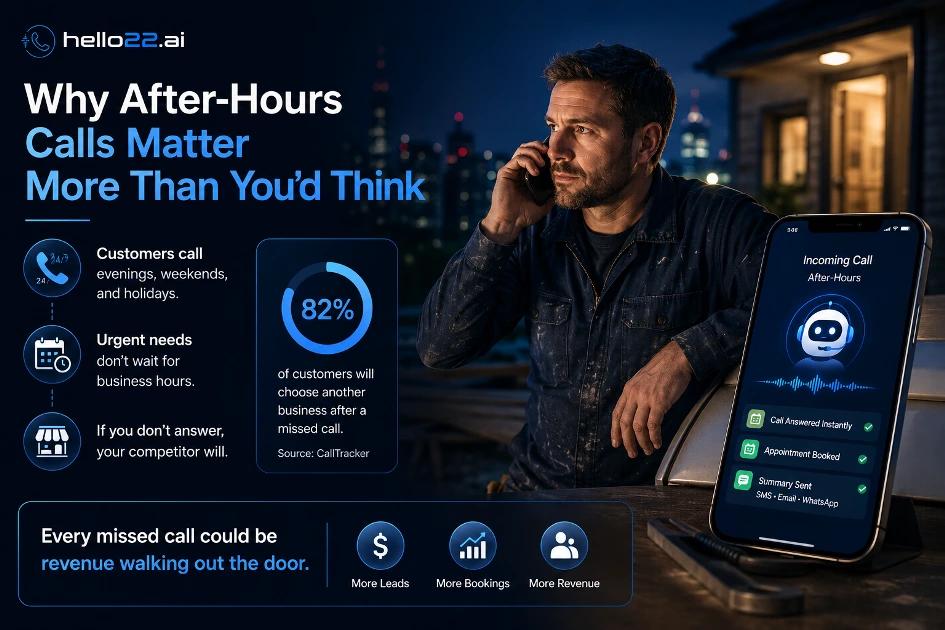
Why After-Hours Calls Matter More Than You'd Think
People who call outside business hours are usually calling because they genuinely can't wait, which makes these calls some of the highest-intent enquiries a business gets.
Think about who actually calls 9pm on a weeknight or 7am on a Saturday. It's rarely someone browsing casually. It's a homeowner whose hot water system just died, a tenant locked out of their unit, or a property buyer who only has evenings free to make calls. These callers are motivated, often ready to book immediately, and usually willing to pay a premium for a fast response.
That's a different kind of caller to someone ringing at 11am on a Tuesday to compare quotes. After-hours callers tend to convert faster and at a higher rate provided someone actually answers.
The Three After-Hours Call Types Every Business Should Plan For
1. Emergency Calls
Emergency trades plumbing, electrical, HVAC, locksmiths see a large share of after-hours volume made up of genuine emergencies: burst pipes, power outages, break-ins. These calls typically have high urgency and high willingness to pay, but they're also the calls most likely to be missed, since the business owner is usually either asleep, with family, or already on another job.
2. Weekend Enquiries
Weekend calls follow a different pattern. Real estate is a clear example Saturday morning, around open-home times, is often peak enquiry time for buyers and sellers. Medical and allied health practices frequently see a similar pattern on Sunday evenings, as people plan their week ahead. Miss these windows, and the enquiry usually goes to whichever competitor's phone (or booking system) responds first.
3. After-Work Calls
A large share of calls to service businesses come in during the early morning (before 9am) or evening (after 5–6pm) precisely when people are free from their own jobs to make personal calls. For businesses without after-hours coverage, this entire window is effectively unattended, even though it may represent a meaningful share of total enquiries.
What Actually Happens When These Calls Go Unanswered
Most after-hours callers don't leave a voicemail, and most of those who do won't wait around for a callback.
The pattern is consistent across multiple independent industry sources, even though the exact percentages vary by report: a large majority of callers who reach voicemail hang up without leaving a message. Of the smaller group who do leave one, many won't wait long for a return call before trying out the next business on their list particularly for anything urgent.
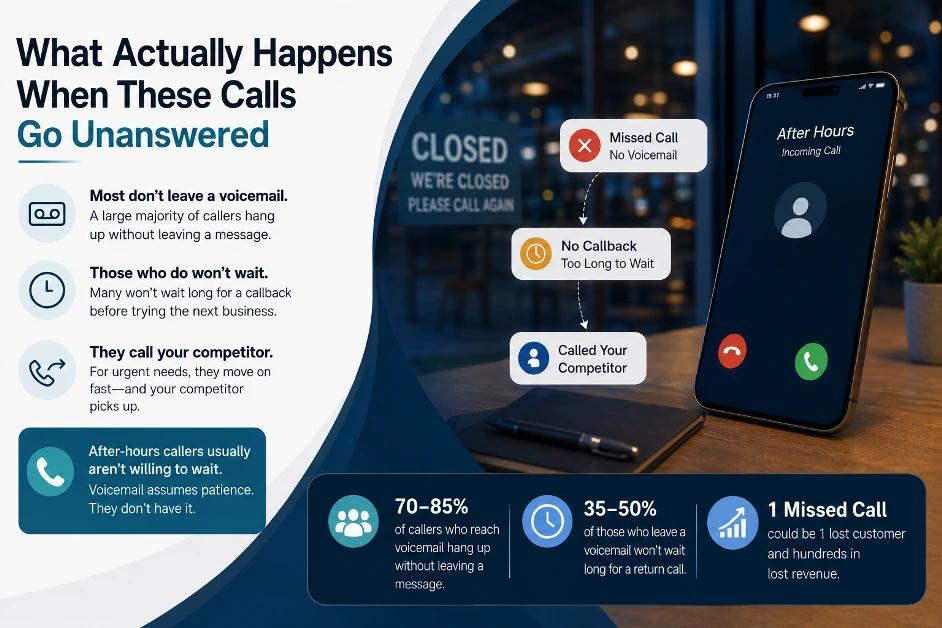
This is the core problem with treating after-hours coverage as "just let it go to voicemail." Voicemail assumes the caller is willing to wait. After-hours and emergency callers usually aren't.
Why Trades and Service Businesses Are Hit Hardest
Industry estimates for missed-call rates among Australian trade and service businesses commonly sit somewhere in the 25–40% range, with solo operators and emergency trades (plumbing, electrical, locksmiths) often reported even higher, simply because staff are physically on the job under a sink, on a roof, driving between sites and can't stop to answer a call.
Missed calls also tend to cluster around predictable windows: before the workday starts, over lunch, and after 5pm which happens to be exactly when tardies are hardest to reach, since they're either between jobs or already finished for the day.
Geography Makes It Worse in Some Cities
The problem isn't identical everywhere. In a geographically spread city like Perth, longer average drive times between jobs mean tardies spend more of the day away from their phone, which several local industry reports point to as a reason Perth-based trades often report higher missed-call rates than more compact markets. Businesses in Sydney and Melbourne face a different pressure density, and competition means a slow response is more likely to lose the customer to a nearby competitor who did answer. Brisbane and South-East Queensland trades often see sharp after-hours spikes during storm season, when emergency call volume can jump well above normal levels for days at a time.
The common thread across all of these: whatever the local cause, the outcome is the same: a call that isn't answered quickly tends to go to whoever answers next.
What a 24/7 AI Receptionist Actually Changes
It removes the single biggest cause of after-hours missed calls; nobody being available to answer.
AI receptionist Like Hello22 AI answers instantly, at any hour, without needing a person on the other end. In practice, that means:
A caller at 10pm gets a real conversation, not a ring-out or a generic voicemail greeting. The AI can ask what the problem is, where they're located, and how urgent it is.
The details get captured properly. Instead of a rushed, half-legible voicemail message, the AI asks structured questions and records the caller's name, number, and issue consistently.
The appointment can be booked on the spot. Where the business allows it, the AI can check calendar availability and confirm a time slot immediately, rather than leaving the caller to wait for a callback.
You get notified straight away. A summary lands by SMS, email, or WhatsApp the moment the call ends, so an after-hours enquiry doesn't sit unseen until the next morning.
This is a meaningfully different outcome to voicemail, where the business owner only finds out about the call if the caller even left one hour later, by which point the customer may have already booked elsewhere.
Real-World Example: A Weekend Emergency Call
It's Saturday, at 7pm, in a Melbourne suburb. A resident's hot water system stops working entirely. They search for an "emergency plumber near me," and call the first result.
Without after-hours coverage, that call rings out or hits voicemail. The plumber is home with family and doesn't see the missed call until Sunday morning. By then, the resident had already called someone else.
With a 24/7 AI receptionist in place, the call is answered immediately. The AI asks a few quick questions: what's happened, is water actively leaking, which suburb checks the plumber's calendar, and offers an appointment for the first thing Sunday morning. The booking is confirmed on the call, and the plumber gets a text with the job details before he's even back from dinner.
Who Benefits Most From 24/7 Call Handling?
After-hours coverage matters most for businesses where calls genuinely can't wait until the next business day:
Emergency trades: plumbers, electricians, locksmiths, HVAC technicians responding to urgent, time-sensitive callouts.
Property managers and real estate agents, tenants: issues and weekend buyer enquiries don't follow a 9-to-5 schedule.
Medical, dental, and allied health clinics: patients often call evenings or weekends to book around their own work hours.
Cleaning, pest control, and other on-site service businesses: customers frequently call after work to arrange service.
Law firms and immigration consultants: particularly for urgent or time-sensitive intake enquiries.
If your business fits any of these patterns, the hours you're currently not covering are very likely to the hours where you're losing the most.
How Hello22 AI Handles After-Hours and Emergency Calls
Hello22 AI is built to answer every call around the clock nights, weekends, and public holidays with a natural-sounding voice rather than a robotic script. It asks the right questions for the situation, checks calendar availability where relevant, and can book the appointment during the call itself. The moment the call ends, you get a summary by SMS, email, or WhatsApp, so an emergency call at midnight doesn't sit unseen until you're back at your desk.
For calls that genuinely need a person with a complex dispute, an unusual request Hello22 AI can be set to transfer the call straight to a team member, with the conversation context carried over, rather than leaving the caller stuck.
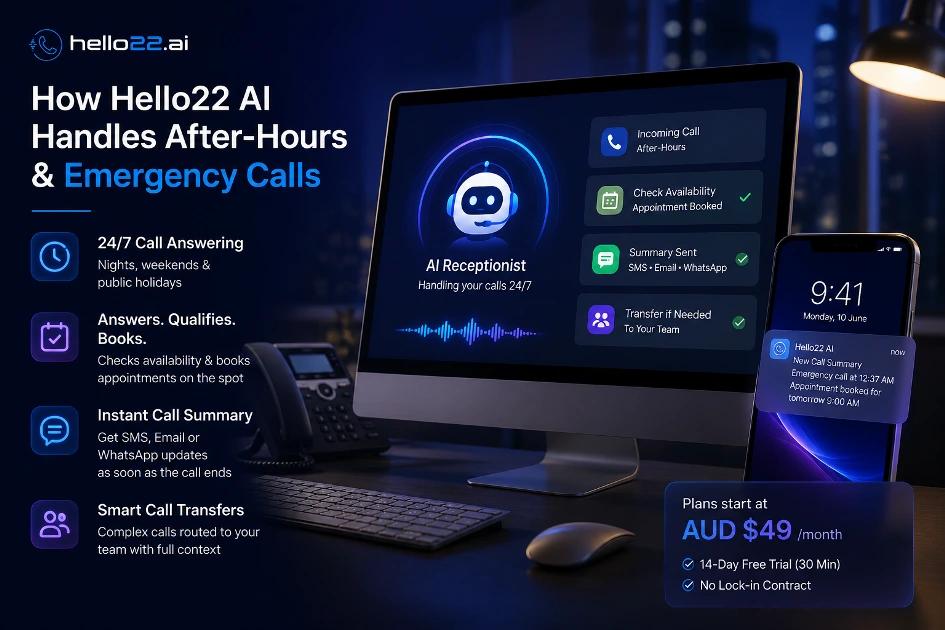
Plans start at AUD $49/month, with a 14-day free trial (30 Min) and no lock-in contract, which makes it a low-cost way to test whether after-hours coverage actually recovers the jobs you suspect you've been missing.
Conclusion
The calls a business misses after 5pm, on weekends, or in the middle of the night aren't lower-value than business-hours calls often, they're the opposite. They're the customer who can't wait, the emergency that needs solving now, the buyer who only has evenings free. A 24/7 AI receptionist exists specifically to make sure those calls get answered instead of quietly going to the next business on the list.
If you're not sure how many after-hour calls your business is currently missing, that's usually the first thing worth finding out. Start a 14-day free trial with Hello22 AI and see how many of those calls turn into booked jobs instead.
Frequently asked questions
Why are after-hours calls more valuable than business-hours calls?
After-hours callers are often dealing with something urgent, an emergency repair, a time-sensitive enquiry which means they're more likely to book immediately with whoever answers first, rather than shopping around across multiple quotes.
What happens to call that go to voicemail after hours?
Most callers who reach voicemail don't leave a message, and of those who do, many won't wait for a callback before calling a competitor particularly for anything urgent.
Which businesses need 24/7 calls handling the most?
Emergency trades, property managers, medical and dental clinics, and any business where customers commonly call outside standard hours to book around their own work schedule.
Can an AI receptionist actually book an emergency job at night, or does it just take a message?
A capable AI receptionist, like Hello22 AI, can check calendar availability and confirm a booking during the call itself, rather than only recording a message for follow-up the next day.
Do all Australian cities have the same after-hours missed-call problem?
The pattern is common everywhere, but the causes differ. Spread-out cities like Perth see more missed calls due to longer drive times between jobs, while dense, competitive markets like Sydney and Melbourne lose customers faster to nearby competitors who answer first.
How much does 24/7 AI call coverage cost for a small business?
Plans typically start around AUD $49/month for providers like Hello22 AI, which is significantly less than paying for after-hours staffing or a dedicated overnight answering service.